
5 Key Terms to Negotiate with OpenAI Before Its IPO
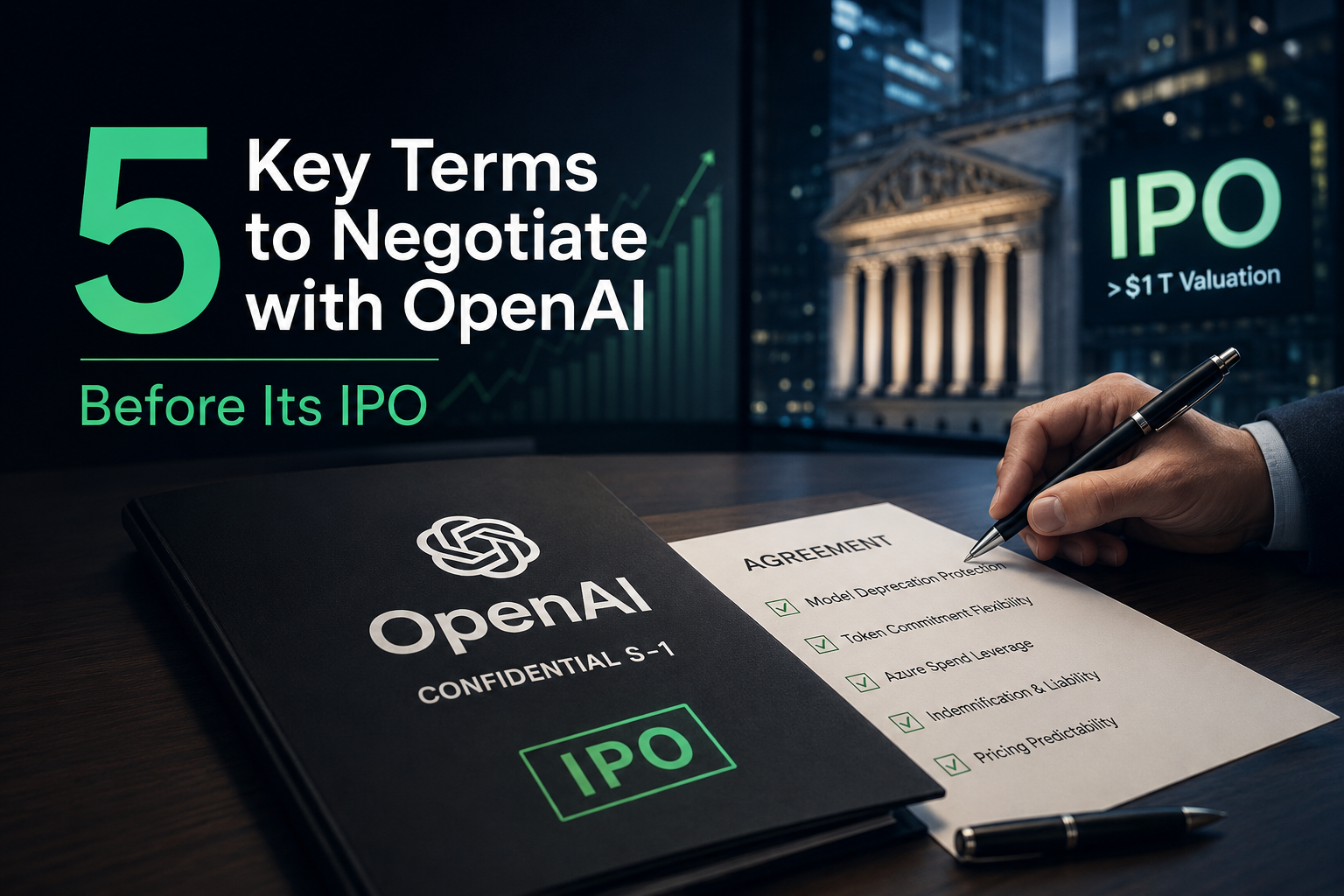
OpenAI filed its confidential S-1 with the SEC in June 2026. The company is targeting a valuation above $1 trillion. And if you are buying OpenAI services today, the commercial dynamics of your deal are about to change.
OpenAI is shifting from adoption-first to revenue-first. During the adoption phase, sales teams discount aggressively, approve custom deal structures, and make concessions to land logos. Post-IPO, Wall Street will scrutinize revenue per customer, discount rates, and margin trends quarter by quarter. The flexibility you can negotiate with OpenAI today will not exist once the stock is trading.
But here is the problem: most procurement teams are negotiating OpenAI contracts the same way they negotiate any SaaS deal. Price caps, renewal protections, volume discounts. That playbook misses what makes OpenAI's commercial model fundamentally different from a traditional software vendor.
OpenAI does not sell software licenses. It sells access to models that change, tokens that fluctuate in cost, and products that span at least five distinct commercial channels. If you negotiate it like Salesforce or ServiceNow, you will leave significant value on the table.
Here are five terms specific to OpenAI's commercial structure that experienced procurement teams should be negotiating right now.
1. Protect Your Unit Economics Against Model Deprecation
OpenAI deprecates models regularly. When a model reaches end-of-life, customers are pushed to a successor. The problem is that successor models often carry different token economics. A newer, more capable model may cost significantly more per token than the one your commitment was priced against.
This creates a hidden cost escalation. Your per-unit rates were locked, but the product those rates applied to no longer exists. You are migrated to a new model, and your actual cost per output quietly increases, sometimes substantially, without any formal price increase hitting your desk.
Most enterprise agreements do not address this. The order form locks pricing for named models, but says nothing about what happens when those models are deprecated.
What to ask for: Negotiate model migration pricing protections. Your agreement should guarantee that when OpenAI deprecates a model and directs you to a successor, the successor is available at equivalent or better per-token rates for the remainder of your term. Also secure a minimum transition period before any model is fully retired from your environment, so your engineering teams are not scrambling to revalidate prompts and workflows on a forced timeline.
Why it matters now: OpenAI's model release cadence is accelerating. Pre-IPO, they have commercial incentive to keep customers happy through transitions. Post-IPO, model upgrades become a natural revenue expansion lever. If your contract does not address deprecation pricing, every model transition is a de facto price increase.
2. Structure Your Token Commitment to Survive Workload Shifts
OpenAI's API pricing is not like a SaaS seat license. It is a consumption model with multiple cost dimensions: input tokens, output tokens, cached tokens, and reasoning tokens. These categories carry very different price points. Reasoning tokens on o-series models, for example, can generate significant hidden cost because the model produces internal "thinking" tokens that you pay for but never see in the response.
On top of that, OpenAI offers cost optimization features like prompt caching, which can dramatically reduce input token costs, and the Batch API, which offers a meaningful discount for asynchronous workloads. Whether your contract entitles you to these features, and at what rates, matters.
Most buyers commit to a dollar amount without specifying how that commitment applies across token types, models, or optimization tiers. That means you can burn through your commitment much faster than expected if your workload shifts toward higher-cost token categories.
What to ask for: Structure your API commitment as a dollar pool that floats across models and token types, not as a commitment tied to a specific model or rate. Ensure your agreement explicitly includes access to prompt caching and Batch API pricing at the rates available at signing, locked for the term. And negotiate the right to reallocate commitment dollars between API consumption and seat-based products if your usage profile shifts mid-term.
Why it matters now: Token economics change with every model generation. Pre-IPO, OpenAI's deal teams can approve flexible commitment structures that let dollars float across products. Post-IPO, product-level P&L accountability will make cross-product flexibility harder to get approved. Lock in the flexible structure while it is available.
3. Use Your Azure OpenAI Spend as Competitive Leverage
Many organizations do not realize they are buying the same underlying models through two completely separate commercial channels: directly from OpenAI and through Microsoft Azure's OpenAI Service. Each channel has its own pricing, discount structures, and sales teams. And in most cases, neither channel knows what you are paying the other.
This is a leverage opportunity that is unique to OpenAI. No other major AI vendor has this dual-channel dynamic. You can use your direct OpenAI spend to negotiate better Azure rates with Microsoft, and simultaneously use your Azure commitment to pressure OpenAI's direct sales team on pricing.
Azure also offers Provisioned Throughput Units (PTUs) for dedicated model capacity, which is a fundamentally different pricing model from OpenAI's pay-per-token approach. For high-volume, latency-sensitive workloads, PTUs can be significantly more cost-effective. For variable workloads, pay-per-token is better. Most buyers do not run the analysis to determine which model fits their usage pattern.
What to ask for: Before signing any OpenAI agreement, map your total OpenAI model consumption across both channels. Use that combined spend as leverage in both negotiations. Ask OpenAI's sales team directly: can you match or beat the effective per-token rate you are getting through Azure? Ask Microsoft the same question in reverse. And negotiate the right to shift workloads between channels during your term without commitment penalties.
Why it matters now: The OpenAI-Microsoft commercial relationship is still evolving. Pre-IPO, OpenAI has strong incentive to pull consumption onto its direct platform to demonstrate direct revenue growth to investors. That gives you leverage to extract better direct pricing. Post-IPO, the relationship may formalize in ways that reduce this arbitrage opportunity.
4. Negotiate Seat-Tier Mixing and Feature Parity Guarantees
OpenAI offers multiple seat-based tiers: ChatGPT Business, Enterprise, and Education. The feature sets differ across tiers, and the price gap between them is significant. But the feature boundaries are not static. OpenAI regularly moves features between tiers, sometimes adding capabilities to lower tiers and sometimes gating new features behind higher ones.
This creates two problems. First, most buyers purchase a single tier for their entire organization, which means paying the highest per-seat rate for users who only need basic access. Second, the features that justified your tier choice at signing may shift during your term, either because OpenAI upgraded the lower tier (meaning you overpaid) or because they moved a critical feature to a higher tier (meaning your current plan no longer meets requirements).
What to ask for: Negotiate the right to mix tiers within a single agreement. Place power users on Enterprise, general users on Business or Education, and retain the right to move users between tiers during the term without penalty. Then add a feature parity guarantee: your agreement should specify that the feature set available to your tier at signing will not be materially reduced during the term. If OpenAI gates a feature you currently have behind a higher tier, you should retain access without upgrading.
Why it matters now: OpenAI's product segmentation is still maturing. Feature gates change frequently, and tier boundaries are being redefined as the company figures out its enterprise go-to-market. Pre-IPO, sales teams have authority to approve mixed-tier deals and feature guarantees. Post-IPO, product management will standardize tier boundaries and resist exceptions. Get the flexible structure now before the packaging hardens.
5. Consolidate Across OpenAI's Commercial Channels Into a Single Agreement
OpenAI does not operate like a single vendor. It operates across what we call multiple "commercial worlds": the direct API platform, ChatGPT Business, ChatGPT Enterprise, ChatGPT Education, Azure OpenAI through Microsoft, and emerging modality-specific products. Each channel has its own sales team, order form structure, pricing model, and renewal timeline.
Most organizations end up with fragmented OpenAI spend spread across three or four of these channels, each governed by a separate agreement. No single account executive sees your total investment. That fragmentation destroys your leverage and creates operational complexity around renewals, compliance, and spend tracking.
What to ask for: Push for a single enterprise agreement that consolidates your direct OpenAI spend across seats and API into one order form with one renewal date and one total-spend discount structure. For Azure OpenAI spend, use your consolidated direct agreement as leverage in your Microsoft negotiation. The goal is to ensure that wherever you consume OpenAI models, you are negotiating from a position of total-spend visibility, not product-level fragmentation.
Why it matters now: Pre-IPO, OpenAI's sales leadership can approve consolidated deal structures because they want to show large, multi-product customer relationships to investors. Post-IPO, each product line will have its own revenue targets and P&L accountability. Cross-product consolidation will require more internal approvals, more stakeholders, and more time. Do it now while one deal desk can say yes.
The Pre-IPO Window Is Closing
These are not generic SaaS negotiation tactics. They are specific to how OpenAI prices, packages, and sells its products today, and to how that commercial model will change once the company goes public.
Right now, OpenAI is in land-and-expand mode. They want large, committed, multi-product customers they can point to in an S-1. That gives you leverage to negotiate terms that will be off the table once quarterly earnings calls start.
The five terms above address the commercial realities that make OpenAI different from any vendor you have negotiated with before: consumption-based token economics, rapid model deprecation cycles, a dual-channel distribution model with Microsoft, evolving product tier boundaries, and a fragmented multi-channel go-to-market. Miss these, and you are leaving real money on the table.
Quick Reference: Five Terms at a Glance
Model deprecation protections. What to ask for: successor model pricing parity and transition periods. What makes it OpenAI-specific: OpenAI deprecates models faster than any enterprise vendor.
Flexible token commitment. What to ask for: dollar pool across models, token types, and optimization tiers. What makes it OpenAI-specific: token economics shift with every model generation.
Azure OpenAI arbitrage. What to ask for: cross-channel pricing leverage and workload portability. What makes it OpenAI-specific: same models, two competing sales channels.
Seat-tier mixing and feature parity. What to ask for: mixed tiers, inter-tier mobility, feature set guarantees. What makes it OpenAI-specific: tier boundaries and feature gates change frequently.
Cross-channel consolidation. What to ask for: single ELA covering all direct spend with unified discount. What makes it OpenAI-specific: OpenAI's "multiple commercial worlds" fragment leverage.
FAQs
When is the OpenAI IPO expected?
OpenAI filed a confidential S-1 with the SEC in June 2026. Reports suggest a public listing between September and November 2026, depending on regulatory approvals and market conditions.
How is negotiating with OpenAI different from negotiating with a traditional SaaS vendor?
OpenAI sells consumption-based access to models, not software licenses. Pricing depends on token type, model version, and access channel. Models are deprecated regularly, and the same product is sold through multiple commercial channels. Traditional SaaS negotiation playbooks do not account for these dynamics.
Can I use my Azure OpenAI spend as leverage with OpenAI directly?
Yes. OpenAI and Microsoft Azure sell access to the same underlying models through separate commercial relationships. Most organizations can use their spend in one channel to negotiate better terms in the other, especially pre-IPO when OpenAI wants to demonstrate direct revenue growth.
What happens to my pricing when OpenAI deprecates a model I am using?
Without model migration protections in your contract, you are typically moved to a successor model at whatever rates OpenAI sets for that model. If the successor is more expensive per token, your effective cost increases without any formal price change.
How do I know if my OpenAI deal is commercially competitive?
OpenAI's commercial model is complex enough that most organizations cannot assess competitiveness without deal benchmarks. FlipThrough analyzes your specific agreement against comparable deals and identifies where you are overpaying or under-protected.
Book Your Free OpenAI Deal Assessment
Not sure if your OpenAI deal is structured to survive the IPO transition? FlipThrough offers a free assessment of your OpenAI agreement, including pricing benchmarks across all of OpenAI's commercial channels, term-by-term commercial analysis, and specific negotiation recommendations. Book your free OpenAI deal assessment today.
Test FlipThrough Today and Unlock Smarter Procurement Insights
Schedule a FlipThrough demo to see how you can streamline contract reviews, unlock value, and drive strategic impact today.