
FlipThrough vs DocuSign: AI Contract Analysis Compared
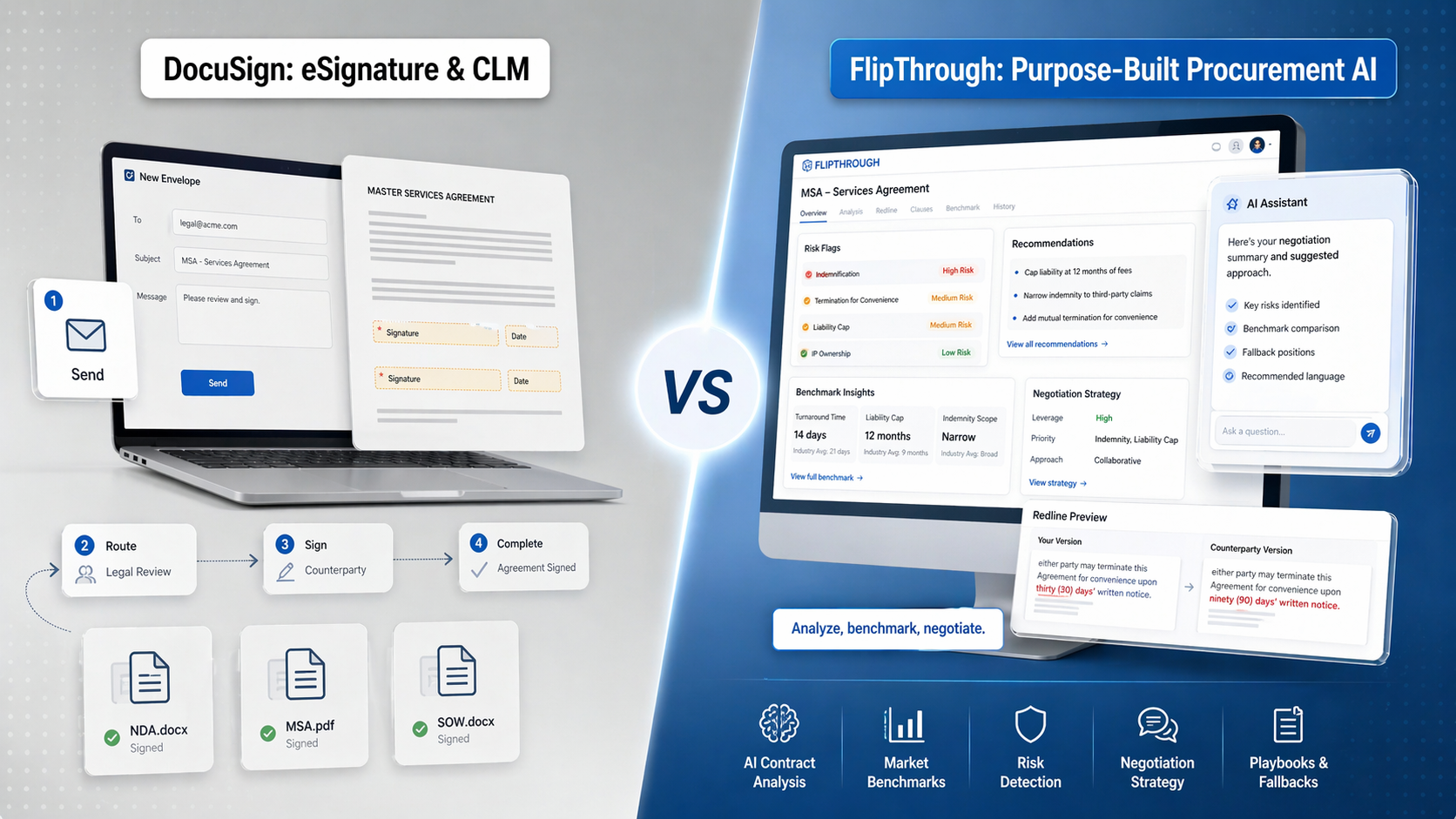
When procurement teams evaluate AI contract analysis solutions, DocuSign often appears as a familiar option. The platform transformed electronic signatures, but its approach to procurement contract management still relies on manual workflows and click-based processes.
FlipThrough represents a new category: AI procurement software solutions built on agentic architecture. Autonomous agents analyze vendor contracts, generate term sheet recommendations, create redlines, and guide live negotiations without requiring prompts or manual intervention.
For organizations seeking to improve their use of AI in procurement, the distinction is critical. One platform added AI features to legacy document management. The other was designed from the ground up as an autonomous negotiation intelligence system.
Procurement Contract Management Software: Manual vs Agentic
DocuSign is SaaS built for the pre-AI era. Users click buttons to route documents, manually review terms, and execute workflows step by step. Even with recent AI features added, the platform requires human action to initiate every process.
FlipThrough is an AI procurement software solution built for autonomous operation. Upload a vendor contract, and specialized agents immediately analyze terms, identify risks, compare against benchmarks, and prepare negotiation materials. This architectural difference defines what each platform delivers for procurement contract management.
How AI Contract Analysis Actually Works in FlipThrough
FlipThrough's agentic platform demonstrates real AI in procurement use cases through specialized autonomous agents.
Autonomous Contract Analysis and Term Sheet Generation
Upload a vendor proposal, and FlipThrough's AI contract analysis agent evaluates every clause against your contracting standards, industry benchmarks, and vendor-specific intelligence. The agent generates a detailed term sheet highlighting key commercial terms, problematic clauses, and financial impact.
Each recommendation is backed by market data showing how similar organizations have negotiated these clauses. What takes a senior analyst 4-6 hours happens in minutes. This represents artificial intelligence contract analysis at scale: consistent, comprehensive, and completely autonomous.
Autonomous Response Evaluation and Counter-Proposal Generation
When you receive a vendor's term sheet response, FlipThrough's recommendation agent analyzes it autonomously and recommends one of three actions for each term:
- Accept: The vendor's position is reasonable based on market norms
- Counter-propose: You have leverage to push for better terms (agent generates the specific language automatically)
- Escalate: The term requires leadership review
For counter-proposals, the agent generates the actual contract markup with tracked changes, explanatory comments, and negotiation talking points. Upload the vendor response at 9 AM, and by 9:05 AM you have a fully marked-up counter-proposal ready to send.
This AI in procurement example shows how agentic systems eliminate manual redlining work entirely.
Autonomous Contract Markup
FlipThrough's redlining agent generates negotiation-ready contract markups in Microsoft Word with zero human input beyond the initial upload. The agent applies your playbook, inserts alternative language, adds comment annotations, and structures documents for efficient vendor review.
This procurement contract management capability operates fundamentally differently from DocuSign's redlining features, which require users to manually identify issues, decide what language to use, and track changes themselves.
Voice Negotiation Agent for Live Vendor Discussions
During vendor negotiations, FlipThrough's voice agent listens and provides real-time guidance. The agent understands contract context, suggests counter-arguments when vendors push back, identifies when the vendor signals flexibility, and edits the contract document in real time as terms are agreed upon.
This AI in procurement use case delivers what traditional procurement negotiation training cannot: expert-level guidance during every live vendor discussion. The agent operates like having a senior procurement advisor in every negotiation, providing talk tracks based on contract specifics and vendor intelligence.
Use of AI in Procurement: Assistive vs Agentic
The procurement contract management software market now includes many platforms claiming "AI-powered" capabilities. But there's a critical distinction between assistive AI and agentic AI procurement solutions.
Assistive AI helps humans work faster by flagging issues or suggesting clauses. DocuSign's AI features are assistive. They highlight potential problems, but procurement professionals must still decide what to do and execute solutions manually.
Agentic AI operates autonomously to complete tasks without human intervention. FlipThrough's agents analyze contracts, generate recommendations, create redlines, and guide negotiations on their own. Humans review outputs and make strategic decisions, but agents handle analytical and tactical work.
For procurement teams evaluating AI contract analysis platforms, this distinction determines whether AI actually reduces workload or just adds features to existing manual processes.
AI in Procurement Examples: Real Impact on Team Performance
Vendor contract negotiation impacts millions in organizational spend. A procurement team managing $50 million in annual agreements can unlock $6 million in cost savings through better negotiations.
But most teams spend 60-70% of their time on low-value tasks like document review. Only 30-40% goes to strategic negotiation.
AI procurement solutions like FlipThrough flip this ratio. The agents handle analytical work, freeing procurement professionals to focus on strategy and high-stakes negotiation. DocuSign can't deliver this transformation because its architecture is fundamentally manual.
What Makes AI Procurement Software Solutions Truly Agentic
True agentic platforms for procurement contract management operate autonomously by default, make context-aware decisions using your organization's standards and vendor history, and complete multi-step workflows without prompting.
FlipThrough's agents analyze contracts, generate term sheets, create redlines, and prepare talking points automatically. They work together from initial analysis through contract execution.
DocuSign has none of these characteristics. It's a document management platform with added AI features, not an AI procurement software solution designed for autonomous operation.
AI in Procurement Use Cases: When to Use DocuSign vs FlipThrough
DocuSign works well for electronic signature capture and executed contract storage. For organizations that need basic document routing and signature management, it serves that purpose.
But for better vendor negotiations, faster contract cycles, and consistent analysis across procurement teams, you need an AI procurement software solution built specifically for these outcomes. FlipThrough delivers 85% faster contract review, 75% less time spent on negotiation, and 8x better commercial terms per vendor deal.
Many organizations use both platforms in complementary roles: FlipThrough handles negotiation with autonomous AI contract analysis and recommendation, then DocuSign manages signature collection and storage once terms are finalized.
Procurement Negotiation Training vs Autonomous Negotiation Intelligence
Traditional procurement negotiation training teaches professionals how to identify leverage points and structure counter-proposals. This training is valuable, but creates variability across team members based on experience.
FlipThrough's agentic approach democratizes negotiation expertise. Junior analysts get the same level of guidance as senior procurement leaders because the AI agents apply consistent best practices, vendor intelligence, and market benchmarks to every negotiation.
The voice negotiation agent functions like having completed advanced procurement negotiation training before every vendor call, providing real-time talk tracks based on contract specifics and vendor behavior patterns.
Conclusion: Choose AI Contract Analysis Built for Autonomous Operation
When evaluating artificial intelligence contract analysis platforms, understand the underlying architecture.
DocuSign is legacy SaaS with AI features added on top. It's built for document management and electronic signatures with analytical tools to help users work faster. The platform still requires manual workflows, click-based processes, and human decision-making at every step.
FlipThrough is an AI procurement software solution built from the ground up for autonomous operation. Specialized agents analyze contracts, generate recommendations, create redlines, and guide negotiations without waiting for prompts. The platform eliminates manual analytical work entirely.
For procurement teams managing millions in vendor spend, this architectural difference determines whether your use of AI in procurement transforms your function or just adds features to existing processes.
Ready to see how agentic AI contract analysis handles vendor negotiations autonomously? Book a demo of FlipThrough and experience procurement contract management software built for the AI era.
Test FlipThrough Today and Unlock Smarter Procurement Insights
Schedule a FlipThrough demo to see how you can streamline contract reviews, unlock value, and drive strategic impact today.