
SAP Just Banned Third-Party AI Agents From Your ERP Data
Estimated reading time: 7 minutes
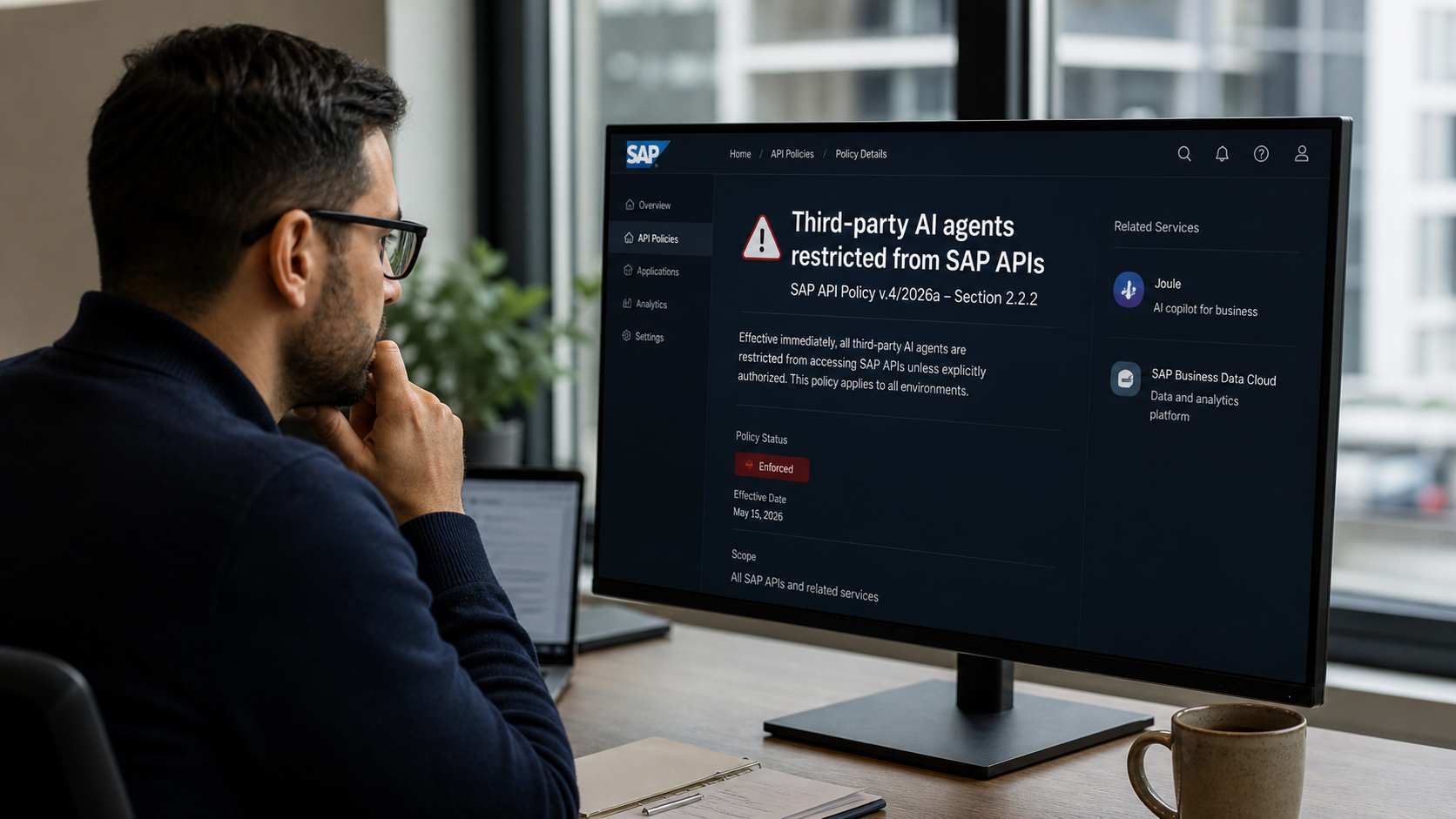
The new SAP API policy has quietly reshaped how enterprises can build and operate AI agents on top of their own SAP data. Released in late April 2026, version 4/2026 of the policy contains a clause that procurement, IT, and finance leaders should not skip past. Section 2.2.2 effectively bans third-party autonomous and generative AI systems from interacting with SAP APIs, except through SAP-endorsed pathways. For customers planning agentic ERP strategies, this is not a minor footnote. It is a structural shift in vendor control, and it deserves a careful consideration.
What Section 2.2.2 Actually Says
The clause is short. The full text from the official SAP API Policy v.4/2026a reads as follows:
2.2.2 GENERAL API CONTROLS — SAP API POLICY v.4/2026a
"Except through and within the limits of SAP-endorsed architectures, data services, or service-specific pathways expressly identified and intended for such purposes, SAP prohibits API use for: (a) interaction or integration with (semi-)autonomous or generative AI systems that plan, select, or execute sequences of API calls, and (b) scraping, harvesting, or systematic and/or large-scale data extraction or replication."
Source: help.sap.com/doc/sap-api-policy/latest/en-US/API_Policy_latest.pdf
In plainer language, the clause prohibits two things outside SAP-endorsed architectures or service-specific pathways:
- AI agents cannot use your SAP data. If an AI tool reads, decides, or takes action using SAP information through SAP's APIs, it is blocked. That includes most agents built on Microsoft Copilot, Anthropic Claude, OpenAI, or any agentic platform that is not SAP's own Joule.
- You cannot pull your SAP data out in bulk. No mass exports, no copying records into another system, no feeding SAP data into a separate analytics or AI platform at scale.
On paper, this is framed as a safeguard for system performance, security, and stability. In practice, it draws a perimeter around your SAP data. Any AI agent that reasons over that data and takes action through APIs must now flow through SAP-approved routes such as Joule, the Joule Agent Gateway, or SAP Business Data Cloud.The policy also names the workarounds it forbids. Customers and partners cannot bypass these controls through proxies, gateways, custom code, or impersonation. That language closes most of the technical doors enterprises would normally use to keep options open.
Why This Matters for SAP Customers Right Now
The timing is not random. Gartner projects that 40 percent of enterprise applications will embed task-specific AI agents by the end of 2026, up from less than 5 percent in 2025. Enterprises are building agent strategies on top of Microsoft Copilot, Anthropic Claude, Google Vertex, and a growing list of agentic ERP and procurement startups.If your SAP data sits at the center of finance, supply chain, HR, or procurement, those agents need access to it. Section 2.2.2 tells you which agents are allowed and which are not. SAP Joule is on the permitted side. Most everything else has to route through architectures SAP defines and updates on its own schedule.The German-speaking SAP user group DSAG has already raised concerns about ambiguity in the language and the risk that customers will hold back on AI pilots while they wait for clarity. That hesitation has a real cost. It slows innovation, delays return on AI investment, and pushes more workloads toward SAP-native tools by default.
If This Pattern Feels Familiar, There's a Reason
SAP customers have been here before. About a decade ago, the company used a similar contract mechanism to control how customers integrated SAP with the rest of their IT stack. It was called indirect access. If you have not heard the term, the short version is worth your time. Section 2.2.2 is running the same play with a new target.
What indirect access was
For decades, SAP licensed its software based on named users. Every person who logged into SAP needed a license. The model started to break when companies began connecting SAP to everything else: Salesforce, e-commerce sites, mobile apps, supplier portals, anything that needed SAP data to do its job.
SAP's position was that even when a person never logged into SAP directly, if a third-party system pushed or pulled data on their behalf, that still counted as using SAP. Every customer placing an order through a web shop, every salesperson pulling data through Salesforce, every IoT sensor feeding records into SAP, all of it required a license. That concept was called indirect access, and the contract language supporting it had been sitting quietly in SAP agreements for years.
The audit that changed everything
The issue exploded in 2017. SAP took beverage giant Diageo to a UK court and won a ruling that the company owed roughly 54.5 million pounds in back-license fees. Diageo's offense was connecting Salesforce to SAP, which let customer service reps and customers themselves trigger SAP transactions without an SAP login. The court agreed those interactions counted as use, and Diageo was on the hook for thousands of unlicensed users.
The ruling sent a shock through the SAP customer base. Audits intensified. Procurement and IT leaders learned a lesson that still shapes contract reviews today: vague language in an SAP agreement can become a multi-million-dollar invoice the moment SAP decides to enforce it. SAP later introduced a new model called Digital Access in 2018 to license indirect use by document count, which conveniently aligned with pushing customers toward S/4HANA.
Why section 2.2.2 is the same playbook
Now look at section 2.2.2 with that history in mind. The mechanics are nearly identical:
- Both clauses target a shift in how customers actually use SAP. Indirect access caught the wave of third-party CRMs, web portals, and mobile apps. Section 2.2.2 catches the wave of AI agents, copilots, and agentic orchestration platforms.Both rely on contract language broad enough to give SAP wide discretion. Indirect access hinged on the definition of "use." Section 2.2.2 hinges on the definition of "SAP-endorsed architectures," a list SAP maintains on its own schedule.Both convert routine technology decisions into compliance exposure. A few years ago it was "did you know connecting Salesforce required more licenses?" Today it is "did you know running an AI agent against your SAP data violates your agreement?"Both nudge customers toward SAP-native alternatives. Indirect access pushed adoption of S/4HANA. Section 2.2.2 pushes adoption of Joule and SAP Business Technology Platform.Call it what it is. Section 2.2.2 is the indirect access of the AI era.
Indirect access then, AI agents now
- Trigger technology:
- Indirect Access (2015 to 2018): Third-party CRMs, portals, web apps.
- Section 2.2.2 (2026): Autonomous and generative AI agents.
- Control mechanism
- Indirect Access (2015 to 2018): Named user and document licensing.
- Section 2.2.2 (2026): API access restricted to endorsed routes.
- Commercial outcome:
- Indirect Access (2015 to 2018): Push toward S/4HANA and cloud.
- Section 2.2.2 (2026): Push toward Joule and SAP BTP.
- Customer risk
- Indirect Access (2015 to 2018): Audit fees, surprise true-ups.
- Section 2.2.2 (2026): Throttling, suspension, blocked AI roadmap.
The Quiet Competitive Strategy Inside the Policy
There is a second story here that does not appear in SAP press releases. The agentic ERP market is heating up. New entrants are building AI-native platforms that promise faster decisions, lower cost of ownership, and a cleaner user experience than legacy ERP. Microsoft, Salesforce, ServiceNow, and a wave of startups are framing themselves as open alternatives for enterprises that do not want every agent action to flow through one vendor.
If a customer can connect a third-party agent platform directly to SAP data, the path to gradual migration becomes easier. The customer keeps the SAP system of record while moving intelligence and user experience to a more flexible layer. Over time, that layer absorbs more of the value, and the SAP core becomes a commodity database. Section 2.2.2 makes that path harder. For procurement and IT leaders evaluating future-proof ERP options, this is a strategic constraint, not just a technical one.
The policy is part of the SAP Documentation, which means it is incorporated by reference into many existing customer agreements. New SAP contracts and renewals will inherit it by default. That makes contract review the most important defensive move you can make right now.
Five practical steps make the difference:
- Map every current and planned AI use case that touches SAP data. Include partner tools, internal pilots, and any analytics workflow that could evolve into an agent.
- Audit your SAP agreements for clauses that incorporate the API Policy by reference. Look for language about Documentation, Documented Use, and Published APIs.
- Negotiate carve-outs that protect existing integrations and reasonable third-party AI agent use cases. Push for written grandfathering.
- Demand transparency on what counts as an SAP-endorsed architecture, with deprecation timelines and a documented update process.
- Watch for similar clauses creeping into other vendor contracts. Where one major vendor leads, others tend to follow within twelve to eighteen months.
Doing this work after signing is far harder. SAP holds the leverage once the renewal is closed.
How FlipThrough Helps You Spot and Negotiate Clauses Like 2.2.2
Clauses like section 2.2.2 are easy to miss. They sit inside policy documents that get incorporated by reference, in language that looks technical rather than commercial. By the time procurement notices the impact, the contract is signed and the leverage is gone.
FlipThrough is built for exactly this problem. The platform reviews vendor agreements and policy attachments automatically, flags risky clauses such as restrictions on AI agents, third-party integration limits, and audit triggers, and provides plain language redlines and negotiation guidance. Procurement teams can see at a glance which suppliers are introducing language similar to SAP section 2.2.2 and respond before that pattern spreads across the IT vendor stack.
The new SAP API policy is a clear signal. The next wave of vendor lock-in will not arrive through pricing pages. It will arrive through quiet updates to policy attachments. Teams that read every clause have an advantage. Teams that automate that review have a bigger one.
Frequently Asked Questions
Does section 2.2.2 of the SAP API policy block all third-party AI agents?
Not entirely. The clause restricts third-party autonomous and generative AI systems from using SAP APIs unless the access flows through SAP-endorsed architectures or service-specific pathways. Customers can still use SAP-approved routes, including the Joule Agent Gateway and SAP Business Data Cloud. The restriction targets direct API orchestration by external agents.
How is this different from SAP indirect access?
Indirect access focused on licensing fees for third-party systems and users that touched SAP data. Section 2.2.2 focuses on technical and contractual permission for AI agents to interact with SAP APIs at all. The structure is similar. SAP defines the perimeter, and customers must work within it or face enforcement actions such as throttling or suspension.
Are existing AI integrations grandfathered?
SAP has indicated through public statements that existing customer integrations and authorized partner solutions should not be affected. User groups including DSAG have asked SAP to put that protection in writing inside the policy itself. Until that happens, customers should treat current integrations as exposed and seek written confirmation during their next renewal.
Could other ERP and SaaS vendors adopt similar language?
Yes. Vendors watch each other closely on commercial terms. If section 2.2.2 holds without major revision, expect similar AI-restriction clauses to appear in other enterprise software policies over the next twelve to eighteen months. Reviewing every supplier agreement for language about AI use, autonomous systems, and API restrictions is now a baseline procurement practice.
What should we do if our renewal is coming up soon?
Treat the renewal as the negotiation window. Map your AI roadmap, identify which use cases depend on third-party agents, and request specific written carve-outs for those workflows. Ask for a defined list of SAP-endorsed architectures with update commitments. Bring procurement, legal, and enterprise architecture into the conversation early.
Ready to see how many clauses like SAP section 2.2.2 are sitting inside your active vendor contracts? Book a 20 minute FlipThrough demo and walk away with a free risk scan of one IT supplier agreement of your choice.
Test FlipThrough Today and Unlock Smarter Procurement Insights
Schedule a FlipThrough demo to see how you can streamline contract reviews, unlock value, and drive strategic impact today.