
5 Key Terms to Negotiate with Anthropic Before Its IPO
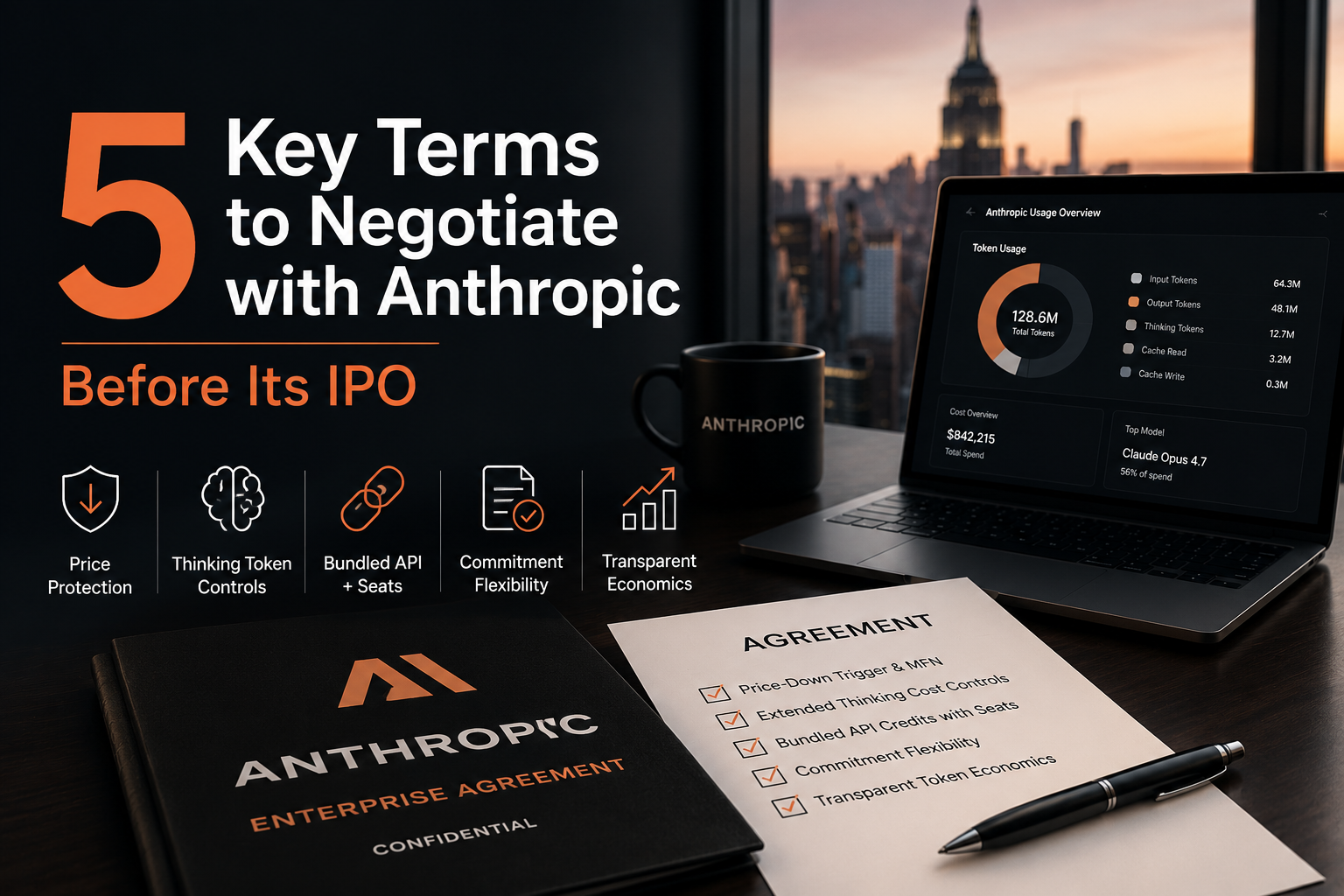
Anthropic filed its confidential S-1 with the SEC on June 1, 2026, just days after closing a $65 billion Series H at a $965 billion valuation. The company is expected to list in late 2026 at a valuation above $1 trillion. If you are buying Anthropic services today, the commercial terms available to you are about to change.
This is a pattern we have seen before. In our recent post on 5 key terms to negotiate with OpenAI before its IPO, we covered how OpenAI's shift from adoption-first to revenue-first will tighten the commercial terms available to buyers. Anthropic is following the same trajectory. And for organizations evaluating both vendors, this creates a strategic opportunity: running a competitive bid process between OpenAI and Anthropic while both are pre-IPO gives you maximum leverage to secure better commercial terms from each.
But the terms worth negotiating with Anthropic are not the same as the ones worth negotiating with OpenAI. Anthropic's commercial model is structurally different. The company operates across six distinct commercial worlds, each with its own pricing logic and contract structure. Its token economics include five separate rate dimensions, a unique manual caching architecture, and a three-tier model family that rewards buyers who understand the mechanics.
Here are five terms specific to Anthropic's commercial structure that experienced procurement teams should be negotiating right now.
1. Price-Down Trigger and MFN Protection
Anthropic has the most aggressive price-cut history of any frontier AI vendor. In November 2025, the company reduced Opus pricing by 67 percent. That was the single largest price reduction in the AI industry. Sonnet pricing has held stable across five model generations. Haiku actually increased when hybrid reasoning was added.
The pattern matters because Anthropic is sitting on a structural cost curve that points further downward. Amazon has committed over $8 billion in direct investment plus a $100 billion compute deal announced in April 2026. As Trainium chip capacity comes online, Anthropic's cost-per-token will continue to drop. The question is whether your contract lets you benefit from those drops or locks you into today's rates.
Most enterprise agreements fix pricing for the term with no mechanism to capture mid-term reductions.
What to ask for: A most-favored-nation (MFN) or price-down trigger clause. If Anthropic reduces published list pricing on any model you consume, the lower rate should automatically apply within 30 days. Reference the November 2025 Opus cut as precedent. Your contract should codify the pattern.
Why it matters now: Pre-IPO, Anthropic's sales teams can approve MFN clauses because the company is optimizing for customer count and total contract value, not margin protection. Post-IPO, every price cut directly impacts gross margin reported to shareholders. Finance teams will resist automatic pass-throughs. Lock in the clause while the incentive structure still favors it.
2. Extended Thinking Cost Controls
Claude's extended thinking feature generates internal reasoning tokens before producing a response. These tokens are billed at the standard output rate, but you never see them in the response. On Opus 4.7, Claude Code defaults to the highest thinking effort setting, which can increase the effective cost per task by a significant margin compared to medium effort.
Most buyers do not realize they are paying for thinking tokens at all. The thinking effort level is set at the API call level, and the default varies by product. Claude Code on Opus 4.7 defaults to the highest setting. If your developers are using Claude Code without configuring effort levels, you are paying a premium on every task without knowing it.
This is unique to Anthropic. No other AI vendor bills for internal reasoning tokens at this scale with this default behavior.
What to ask for: The right to set organization-wide default thinking effort levels in your Enterprise admin console. A contractual cap on thinking token consumption as a percentage of your total token budget. And transparency: your usage reporting should break out thinking tokens separately from output tokens so your procurement team can track the actual cost impact. FlipThrough can benchmark your thinking token spend against comparable deployments and recommend optimization strategies through our AI negotiation agents.
Why it matters now: Pre-IPO, Anthropic wants Claude Code adoption numbers to grow. Sales teams have flexibility to offer thinking token controls as part of Enterprise deals. Post-IPO, thinking tokens become a high-margin revenue line that Anthropic will want to protect. Extended thinking is one of Claude's key differentiators, and monetizing it aggressively is a natural post-IPO move.
3. Bundled API Credits with Seat Commitment
Anthropic operates two separate commercial surfaces: seat-based plans (Team and Enterprise) and consumption-based API access. Most organizations need both. Their business users are on Enterprise seats. Their engineering teams are calling the API to build applications. But Anthropic sells these as separate agreements with separate order forms, separate renewals, and separate sales reps.
This fragmentation destroys your leverage. If those commitments live in two separate agreements, neither sales rep sees your total relationship. You lose volume leverage and operational simplicity.
The fix is straightforward: bundle API credits directly into your Enterprise seat agreement. One order form, one renewal date, one total-spend discount.
What to ask for: A bundled Enterprise agreement that combines seat-based and API consumption in a single order form. Your API token pool should be denominated in dollars, not tokens, so it floats across models and token types. Negotiate a single volume discount calculated against total spend, not separate discounts for seats and API. And ensure your bundled agreement includes access to cost optimization features like prompt caching and batch processing at current rates, locked for the term.
Why it matters now: Pre-IPO, Anthropic's sales leadership wants to show large, multi-product customer relationships to investors. A bundled $350K deal is a better S-1 reference than two separate $200K and $150K agreements. Sales teams have authority to approve consolidated structures. Post-IPO, seats and API will likely have separate P&L targets, making cross-product bundling harder to approve.
4. Pricing Schedule Freeze
Anthropic's standard order form references its published picing page by URL. That pricing page is a live web page that Anthropic can update at any time. If your order form says pricing per the published URL without locking a specific date, Anthropic can change the rates on that page mid-contract and your order form automatically references the new rates.
This is a well-known trap in any experienced negotiator's Anthropic checklist: the order form references a pricing page URL, and Anthropic can update it unilaterally.
Most buyers do not catch this because the rates are not printed in the oder form itself. In traditional SaaS, your rate card is fixed in the order form. With Anthropic, it may not be.
What to ask for: Lock the pricing page reference to a specific snapshot date in your order form. The rates in effect on your execution date should govern the full term, regardless of subsequent changes to the published page. If Anthropic introduces new models or rate categories after execution, your agreement should specify how those are priced: at published rate or at a discount consistent with your existing terms. FlipThrough can identify whether your agreement has this exposure and recommend specific contract language through our AI negotiation agents.
Why it matters now: Pre-IPO, Anthropic's pricing page is relatively stable and rates have mostly trended downward. Post-IPO, the pricing page becomes a lever for margin optimization. New model launches, new token categories, and surcharges for features like web search and code execution can all appear on the pricing page mid-contract. Without a snapshot lock, your costs can increase without a formal price change.
5. Model Tier Routing and Cascade Rights
Anthropic's three-model family creates a cost optimization opportunity that does not exist with single-tier vendors. The spread between the cheapest and most expensive tier is significant. For many workloads, routing the right query to the right tier can substantially reduce spend without meaningful quality loss. FlipThrough can benchmark your current tier mix against comparable deployments and recommend optimal routing strategies through our AI negotiation agents.
The problem is that most enterprise agreements are structured around a single model tier. Your order form names one model, and your volume discount is calculated against that model's rates. If you want to route queries across all three tiers, you need a contract that supports multi-tier consumption within a single commitment. The standard order form does not make this easy.
What to ask for: A unified token commitment pool that covers all three model tiers. Your committed dollar amount should float across Opus, Sonnet, and Haiku without per-model minimums. Negotiate guaranteed access to all three tiers at current published rates for your term. And add the right to shift your tier mix quarterly without rewriting the order form, so you can route more aggressively to lower-cost tiers as your prompt engineering matures.
Why it matters now: Pre-IPO, Anthropic wants to demonstrate broad model adoption across the entire family. Sales teams have incentive to approve multi-tier deals that show Opus, Sonnet, and Haiku all gaining enterprise traction. Post-IPO, each model tier may have its own revenue target. Cross-tier flexibility will require more internal approvals and may come with per-tier minimums. Lock in the unified pool while the structure supports it.
The Pre-IPO Window Is Closing
These are not generic SaaS negotiation tactics. They are specific to how Anthropic prices, packages, and sells Claude today, and to how that commercial model will change once the company goes public.
Right now, Anthropic is in land-and-expand mode. They want large, committed, multi-product customers they can point to in an S-1. That flexibility is a product of the pre-IPO incentive structure, and it will not last.
The five terms above address what makes Anthropic different: an aggressive price-cut trajectory that rewards MFN clauses, hidden thinking token costs that inflate your bill without a price increase, fragmented commercial surfaces that should be bundled, a live pricing page that can shift under your contract, and a three-tier model family where the right routing decision can transform your cost structure. If you negotiate with Anthropic using generic SaaS terms, you will miss all five.
Want to see how FlipThrough's AI negotiation agents can help you negotiate a better deal with Anthropic? Schedule a demo to see how we analyze your Anthropic agreement, benchmark your terms across all of Anthropic's commercial channels, and generate specific negotiation strategies you can use immediately. Schedule your demo today.
Test FlipThrough Today and Unlock Smarter Procurement Insights
Schedule a FlipThrough demo to see how you can streamline contract reviews, unlock value, and drive strategic impact today.